 Add to Chrome
 Add to Firefox
 Add to Edge
PointQ-Bench: Benchmarking Diagnostic and Interpretable Point Cloud Quality Assessment
May 27, 2026
Point cloud quality plays a critical role in 3D acquisition, reconstruction, rendering, and perception, yet existing point cloud quality assessment (PCQA) research remains largely centered on scalar score prediction. In practical inspection scenarios, quality assessment often involves identifying defects, characterizing dominant issue types, assessing downstream usability, and providing evidence-supported descriptions, which are not explicitly evaluated by current benchmarks. We introduce PointQ-Bench, a benchmark designed to extend PCQA from scalar scoring toward comprehensive quality understanding. PointQ-Bench consists of 3,083 point clouds spanning authentic scans, simulated distortions, and AI-generated content, covering eight major issue types. Each sample is annotated with mean opinion scores (MOS), quality levels, issue tags, expert-grounded descriptions, and 12,332 question-answer pairs. The benchmark supports three perception-oriented tasks: anomaly sensing, defect diagnosis, and usability grading, as well as a cognition-oriented task of open-ended quality reporting. To evaluate free-form quality descriptions, we further propose SSFRQ-5D, a five-dimensional evaluation protocol validated through human-AI agreement analysis. Extensive experiments on 14 vision-language models and traditional PCQA baselines reveal a consistent perception-diagnosis gap: while current models exhibit emerging abilities in coarse defect perception, they struggle with grounded diagnosis and quality calibration. Strong 2D MLLMs generally outperform existing 3D VLMs, and the benefit of additional views or point-level inputs is non-uniform, varying across tasks, data sources, and models, particularly under boundary-ambiguous conditions. Overall, PointQ-Bench provides a diagnostic testbed for advancing reliable and interpretable point cloud quality understanding.

VertiCue-Bench: Diagnosing Whether MLLMs Use Height Cues to Resolve 2D Ambiguity in Remote Sensing Natural Scenes
May 25, 2026Multimodal Large Language Models (MLLMs) have recently shown promising progress in geospatial reasoning. However, existing remote sensing benchmarks remain largely 2D-centric, evaluating models primarily on optical appearance. In natural environments, this paradigm breaks down due to severe spectral confusion, where ecologically distinct regions share similar textures but differ fundamentally in vertical structure. In such cases, explicit 3D structural data, such as Canopy Height Models (CHMs), become essential geometric evidence for semantic disambiguation. Yet, it remains unclear whether current MLLMs can genuinely leverage vertical cues to resolve appearance-level ambiguity. To address this gap, we introduce VertiCue-Bench, the first diagnostic benchmark for CHM-grounded geospatial reasoning. VertiCue-Bench comprises 1,534 carefully curated instances across 17 tasks, explicitly disentangling low-level height perception from ambiguity-aware semantic reasoning. Evaluations on 14 state-of-the-art general and remote-sensing-specialized MLLMs, combined with counterfactual modality testing, reveal a striking perception-reasoning dissociation. While models exhibit emerging competence in reading raw CHM height cues, they largely fail to translate geometric perception into reliable semantic reasoning, often underperforming RGB-only baselines when joint constraints are required. Overall, VertiCue-Bench exposes a critical geometry-to-semantics gap in natural scene understanding, offering actionable insights for advancing geospatial MLLMs.
Bootstrapping Exploration with Group-Level Natural Language Feedback in Reinforcement Learning
Mar 04, 2026Large language models (LLMs) typically receive diverse natural language (NL) feedback through interaction with the environment. However, current reinforcement learning (RL) algorithms rely solely on scalar rewards, leaving the rich information in NL feedback underutilized and leading to inefficient exploration. In this work, we propose GOLF, an RL framework that explicitly exploits group-level language feedback to guide targeted exploration through actionable refinements. GOLF aggregates two complementary feedback sources: (i) external critiques that pinpoint errors or propose targeted fixes, and (ii) intra-group attempts that supply alternative partial ideas and diverse failure patterns. These group-level feedbacks are aggregated to produce high-quality refinements, which are adaptively injected into training as off-policy scaffolds to provide targeted guidance in sparse-reward regions. Meanwhile, GOLF jointly optimizes generation and refinement within a unified RL loop, creating a virtuous cycle that continuously improves both capabilities. Experiments on both verifiable and non-verifiable benchmarks show that GOLF achieves superior performance and exploration efficiency, achieving 2.2$\times$ improvements in sample efficiency compared to RL methods trained solely on scalar rewards. Code is available at https://github.com/LuckyyySTA/GOLF.
MedGEN-Bench: Contextually entangled benchmark for open-ended multimodal medical generation
Nov 18, 2025As Vision-Language Models (VLMs) increasingly gain traction in medical applications, clinicians are progressively expecting AI systems not only to generate textual diagnoses but also to produce corresponding medical images that integrate seamlessly into authentic clinical workflows. Despite the growing interest, existing medical visual benchmarks present notable limitations. They often rely on ambiguous queries that lack sufficient relevance to image content, oversimplify complex diagnostic reasoning into closed-ended shortcuts, and adopt a text-centric evaluation paradigm that overlooks the importance of image generation capabilities. To address these challenges, we introduce MedGEN-Bench, a comprehensive multimodal benchmark designed to advance medical AI research. MedGEN-Bench comprises 6,422 expert-validated image-text pairs spanning six imaging modalities, 16 clinical tasks, and 28 subtasks. It is structured into three distinct formats: Visual Question Answering, Image Editing, and Contextual Multimodal Generation. What sets MedGEN-Bench apart is its focus on contextually intertwined instructions that necessitate sophisticated cross-modal reasoning and open-ended generative outputs, moving beyond the constraints of multiple-choice formats. To evaluate the performance of existing systems, we employ a novel three-tier assessment framework that integrates pixel-level metrics, semantic text analysis, and expert-guided clinical relevance scoring. Using this framework, we systematically assess 10 compositional frameworks, 3 unified models, and 5 VLMs.
CLAPS: A CLIP-Unified Auto-Prompt Segmentation for Multi-Modal Retinal Imaging
Sep 10, 2025Recent advancements in foundation models, such as the Segment Anything Model (SAM), have significantly impacted medical image segmentation, especially in retinal imaging, where precise segmentation is vital for diagnosis. Despite this progress, current methods face critical challenges: 1) modality ambiguity in textual disease descriptions, 2) a continued reliance on manual prompting for SAM-based workflows, and 3) a lack of a unified framework, with most methods being modality- and task-specific. To overcome these hurdles, we propose CLIP-unified Auto-Prompt Segmentation (\CLAPS), a novel method for unified segmentation across diverse tasks and modalities in retinal imaging. Our approach begins by pre-training a CLIP-based image encoder on a large, multi-modal retinal dataset to handle data scarcity and distribution imbalance. We then leverage GroundingDINO to automatically generate spatial bounding box prompts by detecting local lesions. To unify tasks and resolve ambiguity, we use text prompts enhanced with a unique "modality signature" for each imaging modality. Ultimately, these automated textual and spatial prompts guide SAM to execute precise segmentation, creating a fully automated and unified pipeline. Extensive experiments on 12 diverse datasets across 11 critical segmentation categories show that CLAPS achieves performance on par with specialized expert models while surpassing existing benchmarks across most metrics, demonstrating its broad generalizability as a foundation model.
UOPSL: Unpaired OCT Predilection Sites Learning for Fundus Image Diagnosis Augmentation
Sep 10, 2025Significant advancements in AI-driven multimodal medical image diagnosis have led to substantial improvements in ophthalmic disease identification in recent years. However, acquiring paired multimodal ophthalmic images remains prohibitively expensive. While fundus photography is simple and cost-effective, the limited availability of OCT data and inherent modality imbalance hinder further progress. Conventional approaches that rely solely on fundus or textual features often fail to capture fine-grained spatial information, as each imaging modality provides distinct cues about lesion predilection sites. In this study, we propose a novel unpaired multimodal framework \UOPSL that utilizes extensive OCT-derived spatial priors to dynamically identify predilection sites, enhancing fundus image-based disease recognition. Our approach bridges unpaired fundus and OCTs via extended disease text descriptions. Initially, we employ contrastive learning on a large corpus of unpaired OCT and fundus images while simultaneously learning the predilection sites matrix in the OCT latent space. Through extensive optimization, this matrix captures lesion localization patterns within the OCT feature space. During the fine-tuning or inference phase of the downstream classification task based solely on fundus images, where paired OCT data is unavailable, we eliminate OCT input and utilize the predilection sites matrix to assist in fundus image classification learning. Extensive experiments conducted on 9 diverse datasets across 28 critical categories demonstrate that our framework outperforms existing benchmarks.
Towards Alignment-Centric Paradigm: A Survey of Instruction Tuning in Large Language Models
Aug 24, 2025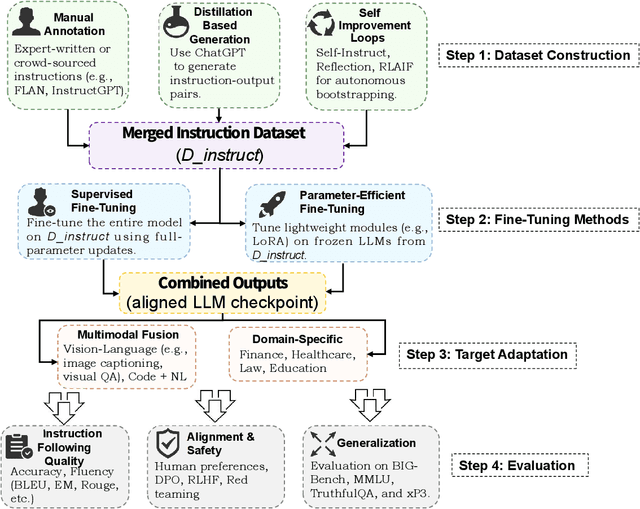
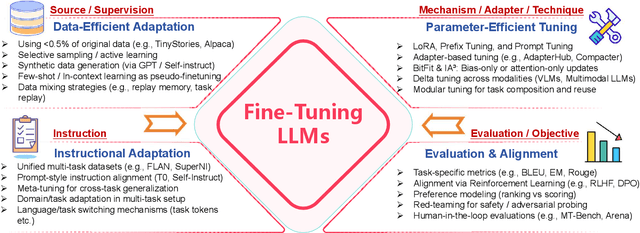
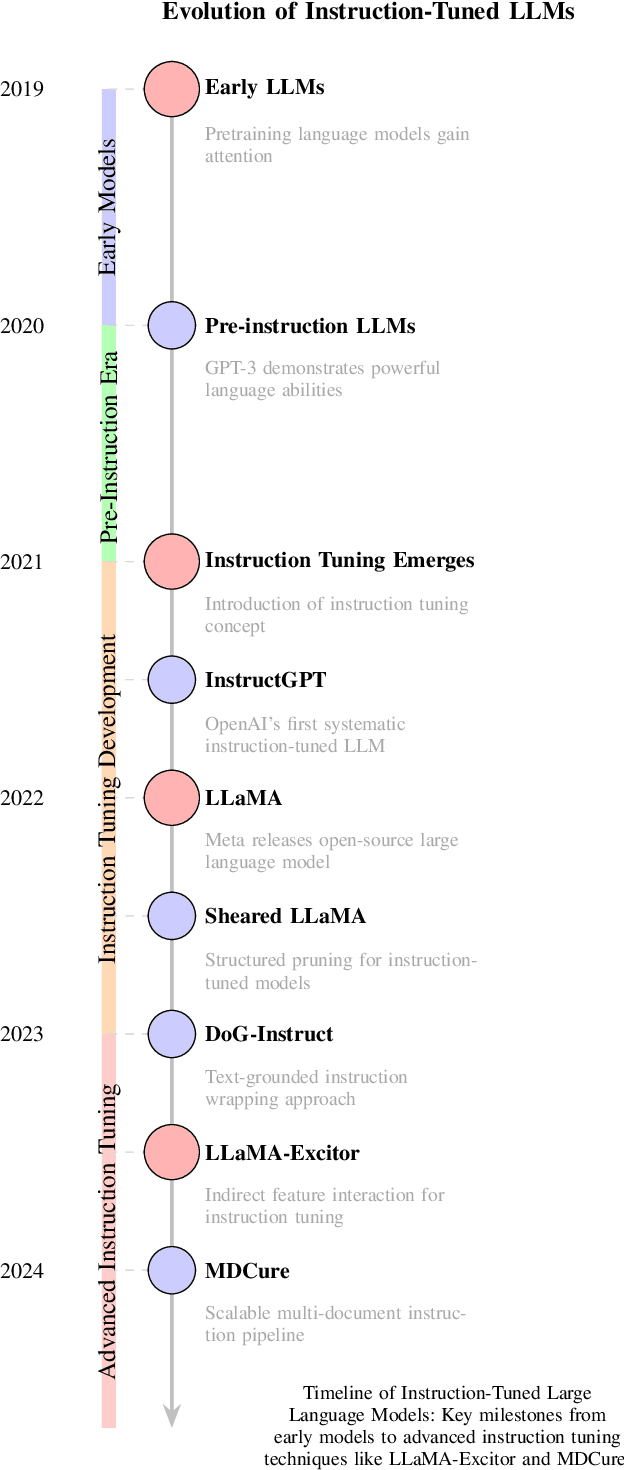
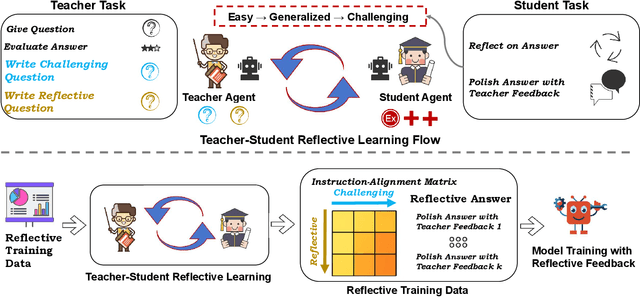
Instruction tuning is a pivotal technique for aligning large language models (LLMs) with human intentions, safety constraints, and domain-specific requirements. This survey provides a comprehensive overview of the full pipeline, encompassing (i) data collection methodologies, (ii) full-parameter and parameter-efficient fine-tuning strategies, and (iii) evaluation protocols. We categorized data construction into three major paradigms: expert annotation, distillation from larger models, and self-improvement mechanisms, each offering distinct trade-offs between quality, scalability, and resource cost. Fine-tuning techniques range from conventional supervised training to lightweight approaches, such as low-rank adaptation (LoRA) and prefix tuning, with a focus on computational efficiency and model reusability. We further examine the challenges of evaluating faithfulness, utility, and safety across multilingual and multimodal scenarios, highlighting the emergence of domain-specific benchmarks in healthcare, legal, and financial applications. Finally, we discuss promising directions for automated data generation, adaptive optimization, and robust evaluation frameworks, arguing that a closer integration of data, algorithms, and human feedback is essential for advancing instruction-tuned LLMs. This survey aims to serve as a practical reference for researchers and practitioners seeking to design LLMs that are both effective and reliably aligned with human intentions.
SphereDrag: Spherical Geometry-Aware Panoramic Image Editing
Jun 13, 2025Image editing has made great progress on planar images, but panoramic image editing remains underexplored. Due to their spherical geometry and projection distortions, panoramic images present three key challenges: boundary discontinuity, trajectory deformation, and uneven pixel density. To tackle these issues, we propose SphereDrag, a novel panoramic editing framework utilizing spherical geometry knowledge for accurate and controllable editing. Specifically, adaptive reprojection (AR) uses adaptive spherical rotation to deal with discontinuity; great-circle trajectory adjustment (GCTA) tracks the movement trajectory more accurate; spherical search region tracking (SSRT) adaptively scales the search range based on spherical location to address uneven pixel density. Also, we construct PanoBench, a panoramic editing benchmark, including complex editing tasks involving multiple objects and diverse styles, which provides a standardized evaluation framework. Experiments show that SphereDrag gains a considerable improvement compared with existing methods in geometric consistency and image quality, achieving up to 10.5% relative improvement.
Exploring Implicit Visual Misunderstandings in Multimodal Large Language Models through Attention Analysis
May 15, 2025Recent advancements have enhanced the capability of Multimodal Large Language Models (MLLMs) to comprehend multi-image information. However, existing benchmarks primarily evaluate answer correctness, overlooking whether models genuinely comprehend the visual input. To address this, we define implicit visual misunderstanding (IVM), where MLLMs provide correct answers without fully comprehending the visual input. Through our analysis, we decouple the visual and textual modalities within the causal attention module, revealing that attention distribution increasingly converges on the image associated with the correct answer as the network layers deepen. This insight leads to the introduction of a scale-agnostic metric, \textit{attention accuracy}, and a novel benchmark for quantifying IVMs. Attention accuracy directly evaluates the model's visual understanding via internal mechanisms, remaining robust to positional biases for more reliable assessments. Furthermore, we extend our approach to finer granularities and demonstrate its effectiveness in unimodal scenarios, underscoring its versatility and generalizability.
A Physics-informed End-to-End Occupancy Framework for Motion Planning of Autonomous Vehicles
May 08, 2025Accurate and interpretable motion planning is essential for autonomous vehicles (AVs) navigating complex and uncertain environments. While recent end-to-end occupancy prediction methods have improved environmental understanding, they typically lack explicit physical constraints, limiting safety and generalization. In this paper, we propose a unified end-to-end framework that integrates verifiable physical rules into the occupancy learning process. Specifically, we embed artificial potential fields (APF) as physics-informed guidance during network training to ensure that predicted occupancy maps are both data-efficient and physically plausible. Our architecture combines convolutional and recurrent neural networks to capture spatial and temporal dependencies while preserving model flexibility. Experimental results demonstrate that our method improves task completion rate, safety margins, and planning efficiency across diverse driving scenarios, confirming its potential for reliable deployment in real-world AV systems.